
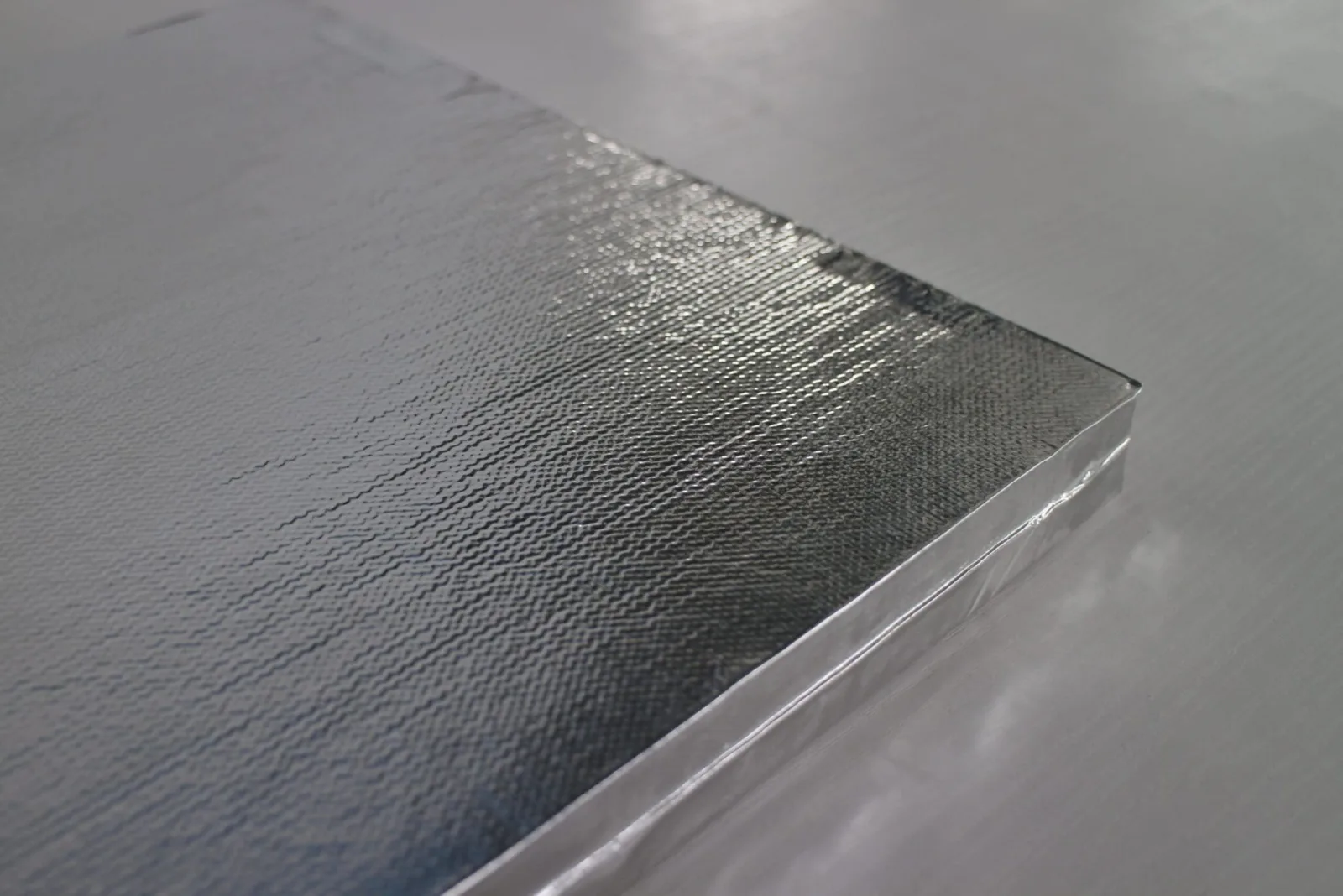
Microporous Board Below the conductivity of still air.
Fumed silica, pressed into a rigid foil-faced board. Its pores are smaller than the distance an air molecule travels between collisions — so the air inside them stops carrying heat.
0.021W/m·K
At 200 °C mean, per the manufacturer's data sheet. Still air at 25 °C conducts 0.026.
¼the thickness
Of ceramic fibre board for the same heat loss at an 800 °C hot face — 25 mm against 99 mm.
3.5×less heat
Through the same 25 mm than ceramic fibre board, at an 800 °C hot face.
1000°C
Classification temperature. A back-up insulation — it goes behind the hot face, not in it.
Comparisons calculated for a single layer: one-dimensional steady state, 40 °C still ambient. Ceramic fibre is the 1260 grade at 300 kg/m³, at typical published conductivity.
Key benefits
Less heat lost
16–20 % less through the wall, in the retrofits we have calculated.
Chamber space
25 mm does the work of 99 mm of ceramic fibre board at an 800 °C hot face.
A lining that holds
Shrinkage of 0.5 % or less after 24 h at 800 °C, per the data sheet.
A cooler, cleaner shell
Casing 9–15 °C cooler in the worked cases; no harmful respirable fibres, per the data sheet.
A fair comparison
Compare it with fibre per unit of insulating value, not per square metre.
Inside the board
Why it insulates better than air.
Ceramic fibre slows heat with air trapped between its strands. This board takes away the air’s ability to carry it. Same wall, two materials, four magnifications.
- Ceramic fibreMicroporous
01The board×1
Rigid, 300 kg/m³, foil-faced on the cold side. It cuts with a knife.
Ceramic fibre Fibre board at the same thickness: a mat of strands and air.
- Ceramic fibreMicroporous
02The matrix×100
Compacted silica with an infrared opacifier dispersed through it. Radiation — the route that takes over above about 500 °C — is scattered within microns.
Ceramic fibre Between the fibres, infrared crosses in straight lines.
- Ceramic fibreMicroporous
03The network×40,000
Fumed-silica particles 7–40 nm across, fused into chains that touch only at points. Heat finds no straight road through the solid.
Ceramic fibre One fibre's edge. The next is tens of microns away.
- Ceramic fibreMicroporous
04The pore×200,000
Pores under 100 nm — about the 68 nm air travels between collisions. A molecule now hits silica more often than other air, so the relay that carries heat breaks down. Convection never starts.
Ceramic fibre Open air. Each molecule meets another every 68 nm and passes its heat on — so fibre can never conduct less than the air inside it.
No fibre can insulate better than the air inside it. This board does.
Thermal conductivity · mean temperature
Below the line no fibre can cross.
Fibre insulates with the air between its strands, so it cannot conduct less than that air — and it loses ground as it heats. Ceramic fibre board more than doubles its conductivity from 200 to 800 °C. This board rises by half.
At 800 °C mean
| Material | W/m·K | Against this board |
|---|---|---|
| Microporous Board300 kg/m³ · this board | 0.032 | — |
| Calcium silicate board250 kg/m³ | 0.120 | 3.8× |
| Ceramic fibre board1260 grade · 300 kg/m³ | 0.160 | 5.0× |
| Ceramic fibre blanket1260 grade · 128 kg/m³ | 0.210 | 6.6× |
| Still airsame temperature, 1 atm | 0.070 | 2.2× |
This board: manufacturer’s data sheet, at mean temperature. Other materials: typical published values for the grade named, for comparison — not a quotation of any one manufacturer’s datasheet. Still air: standard reference values at 1 atm.
Thickness · heat loss
More thermal resistance.
Less lining.
Hold the heat loss and the wall gets thinner. Hold the thickness and less heat gets out. You choose which to keep.
Thickness each material needs to lose as little heat as this board.
25 mm of this board loses as little heat as 99 mm of ceramic fibre board at an 800 °C hot face — 74 mm of wall handed back.
Calculated for a single layer: one-dimensional steady state, hot face held at the stated temperature, 40 °C still ambient, outer surface emissivity 0.30, conductivity taken at each layer’s mean temperature. A comparison of materials — not a prediction for your wall.
Worked linings · by industry
Behind the fire. Never in it.
Pick the plant closest to yours. The board goes behind brick, fibre or castable, where the wall has already cooled — and before we recommend a thickness, we calculate the temperature at that interface and keep it under 900 °C.
CeramicsMorbi · Thangadh · Himmatnagar
The case here Fuel
Gas is the largest cost line in a tile kiln. The board goes behind the sidewall fibre: less heat through the wall, or chamber handed back on the kiln cars.
Roller-hearth tile kiln sidewall · hot face 1150 °C
Existing lining214 mm
- Insulating brick114
- Fibre board100
With microporous189 mm
- Insulating brick114
- Fibre board50
- Microporous25
- Heat through the wall
- 639 to 522 W/m²-18.3 %
- Casing temperature
- 129 to 116 °C−13 K
- Wall thickness
- 214 to 189 mm−25 mm
- Board’s own hot face
- 683 °Cunder the 900 °C we design to
Furnace buildersSpecified from the start, it lets you build a smaller shell for the same heat loss — less steel, less freight, less floor space on every unit you sell.Compare thicknesses →
Worked examples, calculated with the same one-dimensional model and typical published conductivities for the other layers. Joints, anchors and openings add loss a one-dimensional model does not see, and wall loss is one part of a furnace’s fuel use — a fifth less through the wall is not a fifth less gas.
Where it earns its place
- Back-up behind brick, fibre or castable, with the interface below about 900 °C.
- Walls that cannot get thicker — existing shells, kiln cars, shuttle-kiln doors, coil back-ups.
- Anything lifted, swung or moved: doors, crowns, ladles, launders.
- Hot spots and local repairs, in 5–20 mm sections where no fibre product fits.
- Pharma, food and ceramic white bodies — no organic binder to burn off, and no harmful respirable fibres per the manufacturer's data sheet.
We’ll tell you when not to buy it
If your wall is one of these, we will say so before you order — not after it fails.
- As a hot face. It has no resistance to abrasion, slag or flame.
- Anywhere in the wall above 1000 °C.
- Load-bearing positions — hearths, kiln-car decks, floors under product.
- In contact with molten metal, slag, glass or flux.
- Persistently wet or immersed service, even in the hydrophobic grade.
- Below about 400 °C, if the case rests on fuel savings alone.
Before you ask
The questions every plant asks.
It costs more than ceramic fibre board. Why pay for it?
Per square metre it costs more. Per unit of insulation the gap closes: 25 mm does the work of 99 mm of ceramic fibre board at an 800 °C hot face, and on a retrofit the fibre it replaces is material you no longer buy. Send us the wall and we will price both linings side by side — per unit of thermal resistance, at your hours and your fuel.
How can 25 mm beat my 100 mm of fibre?
Fibre insulates with the air trapped between its strands, so it can never conduct less heat than that air. This board's pores are smaller than the distance an air molecule travels between collisions, so the air inside stops carrying heat: 0.021 W/m·K at 200 °C mean, per the data sheet, against 0.026 for still air at 25 °C. Thickness is what you pay for. Resistance is what you buy.
See it at four magnifications →My furnace runs at 1250 °C. Isn't a 1000 °C board too low?
It never sees your hot face. It goes behind brick, castable or fibre, where the wall has already cooled. For every design we calculate the temperature at the board's own face and keep it under 900 °C — behind the 1150 °C face of the tile kiln, it sits at 683 °C.
The tile-kiln lining →Will it save fuel on a thermic-fluid heater or a dryer?
Not much, and we will not sell it to you on fuel. Below about 400 °C there is little heat to save: on the 350 °C heater it takes 3.5 % off the heat through the wall. Where it earns its place at those temperatures is space — that wall is 40 mm thinner — weight, and a lining with no fibres or binders.
The 350 °C lining →What happens in the monsoon, or if it gets wet?
Keep the standard grade dry. For washdown areas, condensing zones and monsoon storage there is a hydrophobic grade — water-repellent, not waterproof, and not for immersed service. Store boards wrapped, on pallets, off the floor. If a board gets soaked, tell us before it goes in: trapped water turns to steam on first firing.
Can our own fitters install it?
Yes. It cuts with a fine-tooth saw or a sharp knife — on a supported bench, not on the furnace. Fit it with the foil facing the cold side, stagger the joints between layers so none runs straight through the wall, and hold it with the existing anchors rather than adhesive alone. Standard boards are 1000 × 600 or 900 × 500 mm, 5–50 mm thick; custom sizes are available to your drawing.
Does it shed fibres like ceramic fibre?
No harmful respirable fibres and no organic binder, per the manufacturer's data sheet — it is pressed silica with a small share of reinforcing fibre. Cutting it still makes a fine dust, so cut with extraction or wet, and wear glasses, gloves and a mask.