Brick, Castable, Plastic or Fibre? A Refractory Selection Guide That Starts With the Duty
Material selection · Bricks · Castables · Ceramic fibre · Insulation · 14 min read
Anuj Traders · Technically reviewed by Nihar Anuj Desai ·
Refractory selection goes wrong when it starts with a temperature rating. Peak temperature is the easiest requirement to meet and the least likely to be what kills your lining. This guide works through the six questions that actually determine the material, and maps them onto the seven families a plant normally buys.
Ask most buyers what refractory they need and the answer is a temperature. Temperature is the easiest requirement in the specification to satisfy, and it is almost never what ends a campaign. Linings die from slag chemistry, alkali vapour, thermal cycling, abrasion, molten metal wetting and mechanical stress — and each of those points at a different material.
The short version: decide the duty first, in six questions. The family follows from the duty. The grade within the family follows from the numbers. And almost every real lining is a system of two or three materials, not one.
The six questions
1. What is the continuous hot-face temperature — and what is the peak?
Continuous operating temperature sets the class. Peak excursions set the safety margin. A material's classification temperature is a laboratory figure measured under defined conditions, not a promise about your furnace: contact with slag, load at temperature and reducing conditions all lower the usable limit. Specify against continuous duty with a sensible margin, and check the datasheet's reheat-change and refractoriness-under-load figures rather than the headline number.
2. What is the atmosphere, and what touches the lining?
This is the question that most often decides the family. Pick what is in contact:
Figure 1 — the question that decides the family
What physically touches the lining?
Select the contact medium
Alumino-silicate systems
Fireclay and high alumina. The chemistry is compatible, so the driving force for dissolution is low.
Within the family, pick alumina level for refractoriness and slag resistance — not on the assumption that higher is always better.
Basic refractories
Magnesite and magnesia-based grades. Putting an alumino-silicate against basic slag, or the reverse, is a classic and fast failure.
Watch storage: basic materials are sensitive to hydration during long idle periods. Store dry, keep dry.
Low-porosity or alkali-resistant grades
Cement preheaters, calciners, some boilers. The reaction with an alumino-silicate matrix is expansive — it grows the brick from the inside, closes the joints and lifts the lining out of line.
This is the deciding property in a preheater, not hot strength. And a very low-porosity brick and an alkali-resistant brick are two different products.
Dense hot faces, tight joints — and process control
Increasingly the deciding factor wherever RDF, tyre chips or industrial waste are burned. Volatiles condense as salts inside cooler brickwork and drive structural spalling.
Material buys time. The durable fix is upstream: a bypass, or feed and fuel control.
Low-iron, CO-resistant grades
Carbon deposits inside the refractory, catalysed by metallic iron, and cracks it apart from within — fastest between roughly 400 °C and 600 °C.
So this is a cold-end specification: ducts, offtakes, recuperators. Ask for grades certified for CO resistance.
Non-wetting castables only
Conventional castables are wetted, penetrated and destroyed by corundum growth. Non-wetting grades carry barrier-forming and pore-blocking additives.
The additives do not compensate for high porosity — the lining still has to be installed dense and dried out properly.
Acid-resistant brick and matched bedding
Acid-resistant brick with the appropriate chemically resistant bedding and jointing materials. The jointing is not an afterthought here — it is the exposed surface between the bricks.
The insulating families earn their place
This is where insulating firebrick, insulating castable and ceramic fibre can work at the hot face, and where their very low thermal mass is a real operational advantage on a cycling furnace.
The qualifiers matter: clean, low-velocity, non-abrasive, no mechanical loading.
3. Is there abrasion, erosion or impact?
Dust-laden gas in cyclones and ducts, circulating bed material in CFBC boilers, falling charge, sliding solids. Erosion resistance tracks with hardness, aggregate quality and cold crushing strength — which usually means a dense, low-cement castable or a hard-fired brick rather than an insulating material at the hot face. Insulating castables and fibre put in a high-velocity or abrasive position wear out regardless of their temperature rating.
4. How often does it cycle?
A furnace that is heated and cooled daily is a different problem from one that runs continuously for a year. Thermal shock resistance improves with a lower elastic modulus and lower thermal mass — which is why very dense, very strong materials can be exactly the wrong answer for batch operation, and why fibre and plastics do so well there. If cycling is severe, weight cycling ability above hot strength.
5. What is the geometry, the access and the shutdown window?
This decides shape versus monolithic, and which application method the material has to suit — a mix formulated for gunning is not the mix for vibration casting. See the application methods guide. Complex, congested or one-off geometry favours monolithics and precast shapes; regular, repetitive geometry with long campaigns often still favours brick.
6. What is the insulation target?
Almost never the hot-face material's job. Hot-face materials are chosen to survive; insulation is chosen to keep the heat in and the shell cold. Trying to do both with one layer is the most common cause of both a hot shell and a short campaign.
The families, and where each earns its place
Figure 2 — the shelf
Seven families, one duty each
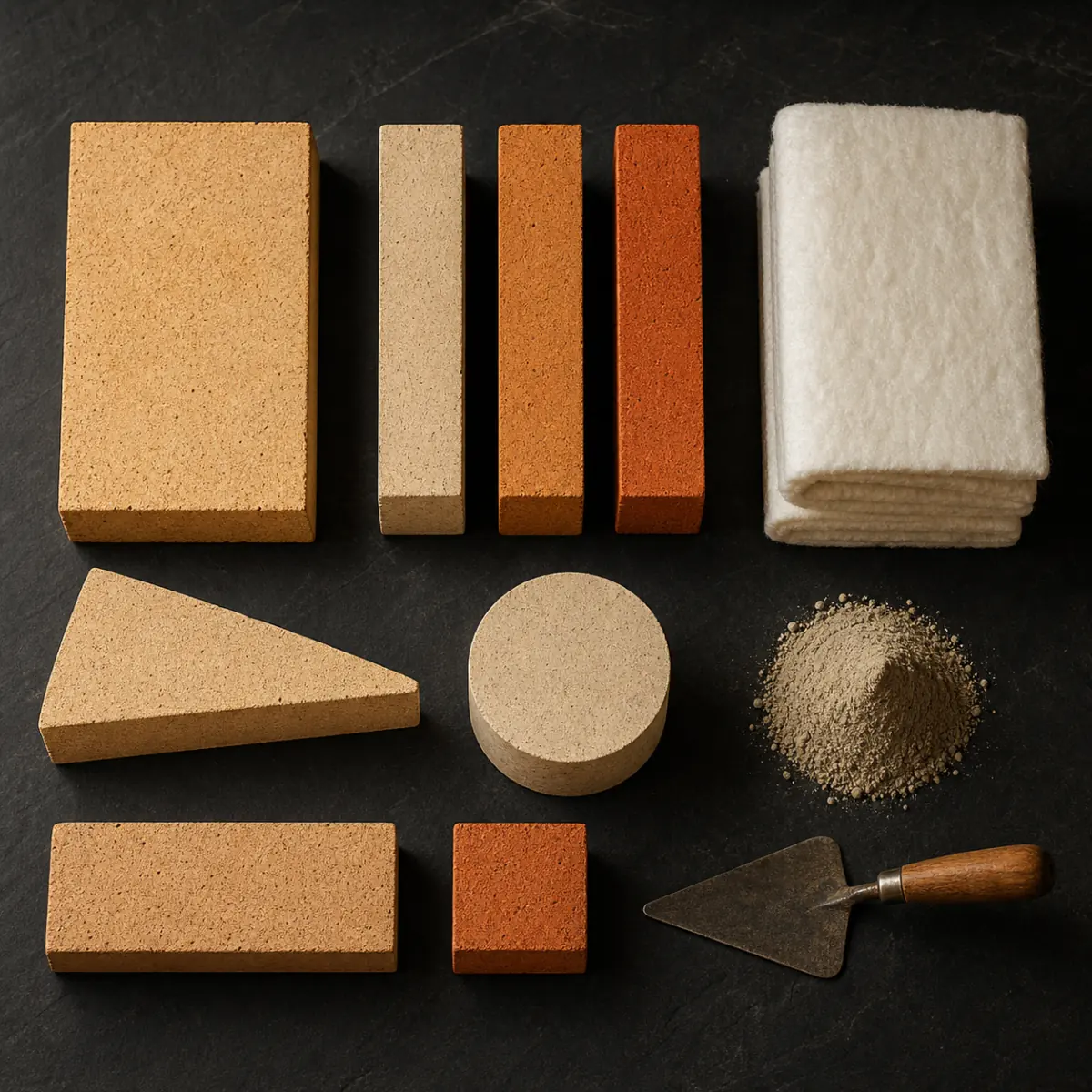
Figure 3 — qualitative, not a datasheet
Where each family is strong and where it is not
| Refractoriness | Slag & melt | Abrasion | Thermal cycling | Insulation | Speed to install | |
|---|---|---|---|---|---|---|
| Fireclay / high alumina brick | Fireclay / high alumina brick · Refractoriness: This is what it is for | Fireclay / high alumina brick · Slag & melt: Good | Fireclay / high alumina brick · Abrasion: This is what it is for | Fireclay / high alumina brick · Thermal cycling: Good | Fireclay / high alumina brick · Insulation: Limited | Fireclay / high alumina brick · Speed to install: Limited |
| Basic brick (magnesite) | Basic brick (magnesite) · Refractoriness: This is what it is for | Basic brick (magnesite) · Slag & melt: This is what it is for — against basic slag; the ranking reverses against acid slag | Basic brick (magnesite) · Abrasion: Good | Basic brick (magnesite) · Thermal cycling: Limited | Basic brick (magnesite) · Insulation: Limited | Basic brick (magnesite) · Speed to install: Limited |
| Insulating firebrick | Insulating firebrick · Refractoriness: Good | Insulating firebrick · Slag & melt: Not its job | Insulating firebrick · Abrasion: Not its job | Insulating firebrick · Thermal cycling: Good | Insulating firebrick · Insulation: This is what it is for | Insulating firebrick · Speed to install: Good |
| Dense castable | Dense castable · Refractoriness: This is what it is for | Dense castable · Slag & melt: This is what it is for | Dense castable · Abrasion: This is what it is for | Dense castable · Thermal cycling: Good | Dense castable · Insulation: Limited | Dense castable · Speed to install: Good |
| Insulating castable | Insulating castable · Refractoriness: Good | Insulating castable · Slag & melt: Not its job | Insulating castable · Abrasion: Not its job | Insulating castable · Thermal cycling: Good | Insulating castable · Insulation: This is what it is for | Insulating castable · Speed to install: Good |
| Plastic refractory / ramming mix | Plastic refractory / ramming mix · Refractoriness: This is what it is for | Plastic refractory / ramming mix · Slag & melt: Good | Plastic refractory / ramming mix · Abrasion: This is what it is for | Plastic refractory / ramming mix · Thermal cycling: This is what it is for | Plastic refractory / ramming mix · Insulation: Limited | Plastic refractory / ramming mix · Speed to install: Good |
| Ceramic fibre | Ceramic fibre · Refractoriness: Good | Ceramic fibre · Slag & melt: Not its job | Ceramic fibre · Abrasion: Not its job | Ceramic fibre · Thermal cycling: This is what it is for | Ceramic fibre · Insulation: This is what it is for | Ceramic fibre · Speed to install: This is what it is for |
| Calcium silicate | Calcium silicate · Refractoriness: Limited | Calcium silicate · Slag & melt: Not its job | Calcium silicate · Abrasion: Not its job | Calcium silicate · Thermal cycling: Good | Calcium silicate · Insulation: This is what it is for | Calcium silicate · Speed to install: This is what it is for |
- Not its job
- Limited
- Good
- This is what it is for
Fireclay and high alumina brick
The workhorse of alumino-silicate duty, sold by alumina content — commonly across a 30% to 80% range, with higher alumina generally bringing higher refractoriness and better resistance to many slags, at higher cost and usually greater weight and thermal mass.
- Use where: the duty is stable, the geometry is regular, the campaign is long, and a proven brick quality beats an equivalent monolithic — rotary kilns, heat treatment furnaces, boiler and heater walls, ladles' safety linings, coke ovens.
- Do not assume "higher alumina is better". Higher alumina is better against many slags and at higher temperature; it is not automatically better against alkali attack, thermal cycling or acid condensate, and it costs more per brick and per kilo of thermal mass.
- Pair with the right mortar. Joint quality decides brickwork life; the mortar's grade should suit the brick and the duty.
Basic brick (magnesite and magnesia-based)
Chemistry-matched to basic slags and to cement clinker chemistry.
- Use where: basic slag or clinker contact — steel ladles and furnace zones, cement kiln burning zones, non-ferrous applications.
- Watch: basic materials can be sensitive to hydration during storage and long idle periods. Store dry, keep dry, and be careful with long shutdowns.
Insulating firebrick (lightweight, porous brick)
Low density, low thermal conductivity, low thermal mass — insulation with the handling convenience of a brick.
- Use where: backup insulation behind a dense hot face, or as a hot face only in clean, low-velocity, non-abrasive, chemically mild duty such as many kiln and heat-treatment applications.
- Do not use where: there is abrasion, slag or melt contact, high gas velocity or significant mechanical loading. Its porosity is the point, and porosity is also the route in for anything corrosive.
Dense castables — conventional and low-cement
Monolithic alumino-silicate materials placed by casting, pumping, gunning or shotcreting.
- Conventional (higher-cement) castables: more forgiving on site, wider water window, simpler dryout. The default where duty is moderate and installation conditions are imperfect.
- Low-cement and ultra-low-cement castables: less water, less lime in the bond, higher density and strength, better hot properties and slag resistance. The trade is a narrower water window, tighter mixing and placing discipline, and a less forgiving dryout — never carry a conventional castable's schedule across to a low-cement mix.
- Use where: complex geometry, one-off shapes, repairs, and anywhere a monolithic lining removes the joints that a brick lining would introduce.
Figure 4 — the choice inside the family
Conventional versus low-cement castable
| Conventional (higher cement) | Low-cement / ultra-low-cement | |
|---|---|---|
| Mixing water | More — wider acceptable window (the better answer for this duty) | Less — narrow window, measured not judged |
| Lime in the bond | Higher | Lower (the better answer for this duty) |
| Density and strength | Adequate for moderate duty | Higher (the better answer for this duty) |
| Hot properties and slag resistance | Moderate | Better (the better answer for this duty) |
| Tolerance of imperfect site conditions | Forgiving (the better answer for this duty) | Unforgiving — needs a real mixer and discipline |
| Dryout | Simpler (the better answer for this duty) | Less forgiving — finer pore structure, despite less water |
| Best fit | Moderate duty, imperfect installation conditions | Aggressive duty, competent crew, real dryout window |
Insulating castables
The monolithic equivalent of insulating brick — low density, low conductivity, cast or gunned as backup insulation, or as a hot face in mild duty.
- Use where: backup layers, roofs, irregular cavities, and where continuity matters more than a fitted board layer.
- Watch: the same limits as insulating brick, plus a real dryout requirement. Being lightweight does not make them forgiving on heat-up.
Plastic refractories and ramming mixes
Supplied ready to use in stiff form, rammed into place and compacted.
- Use where: severe thermal cycling and mechanical duty, burner blocks and quarls, tap holes and spouts, induction furnace linings, and complex shapes that are hard to cast — often giving excellent thermal shock resistance and fast return to service.
- Watch: properties depend on compaction, so the installation crew matters more than with a poured castable.
Mortars and grouting cements
Not an afterthought. A brick lining's weakest and most permeable plane is its joints, and joints are where alkali and sulphur salts condense and where spalling starts. Match the mortar grade to the brick and the duty, use the specified setting type, and lay joints thin and fully filled. Grouting cements have their own role in filling and bedding rather than in bricklaying — use each for what it is.
Ceramic fibre — blanket, module, paper, bulk fibre, LRB mattress
Very low thermal mass, very low conductivity, fast to install, outstanding under thermal cycling.
- Use where: cyclic furnaces, low thermal mass linings, backup insulation, hot face in clean low-velocity duty, expansion joint filling, seals and gaskets.
- Watch: limited resistance to abrasion, high gas velocity, slag, molten metal splash and mechanical damage; performance degrades if the fibre is compressed or wetted. Also note the health classification question — conventional aluminosilicate refractory ceramic fibre (RCF) is classified as a category 1B carcinogen under the EU CLP regulation, while low-biopersistence alkaline earth silicate (AES) wools are not classified as carcinogenic. Where handling exposure is a concern, ask for the AES option and the current safety data sheet.
Calcium silicate board, block and pipe sections
Rigid, low-conductivity, load-bearing backup insulation — behind hot-face linings, under hearths, on pipework and vessels.
- Use where: you need a dimensionally stable insulating layer that can take load, or clean pipe and vessel insulation.
- Watch: temperature limits are considerably lower than hot-face materials, and the material must be protected from crushing by the expansion of the layers in front of it. Confirm the grade's rating and any moisture handling requirements from the datasheet.
Most linings are a system, not a material
A typical wall reads, from the process outwards:
Figure 5 — the build-up
One wall, four jobs
Process side — flame, slag, melt, dust
-
Hot face
Survive the chemistry, temperature, abrasion and cycling
Dense castable · high alumina or basic brick · plastic refractory
-
Backup
Insulate, and support the hot face
Insulating castable · insulating firebrick
-
Shell insulation
Keep the shell cool and the heat in
Ceramic fibre blanket or board · calcium silicate
-
Joints and seals
Absorb expansion, block leak paths
Fibre for expansion joints · the correct mortar grade for brickwork
Shell — the steel you want to keep cool
Two rules follow from this:
- Stagger the joints between layers. Aligned joints are a straight heat path to the shell and a straight path in for anything corrosive.
- Do not let soft layers absorb hard-layer errors. A fibre or calcium silicate layer crushed to half its thickness to make the brickwork fit has lost most of its insulating value and will be blamed later for a hot shell.
Five selection mistakes worth naming
- Specifying on peak temperature alone. It is the easiest requirement to meet and rarely the failure mode.
- Buying up-grade to fix a mechanical problem. If the lining is failing because of closed expansion joints, kiln ovality or anchor design, a higher-alumina brick buys a slightly more expensive short campaign. Diagnose first — how to read a failed lining.
- Using an insulating material as a hot face in abrasive or slag duty. Porosity is the whole point of the material and the whole problem in that position.
- Mismatching chemistry. Alumino-silicate against basic slag, or basic against acid, fails quickly and predictably.
- Choosing a grade the site cannot install correctly. An ultra-low-cement castable placed by a crew without a proper mixer, measured water and a real dryout window will underperform a conventional castable placed well. Specify for the installation you will actually get.
What to send us for a recommendation
Figure 6 — the six questions, as an enquiry
The selection brief
A quote issued against a product name and a tonnage is a price. This list is what turns it into a recommendation.
Duty
Reality on site
From that we can propose a system across the ranges we distribute — high alumina, acid-resistant, magnesite, insulating and custom-shaped brick; conventional, low-cement and insulating castables; plastic refractories; mortars and grouting cements; ceramic fibre; and calcium silicate insulation — and tell you which layer is doing which job and why.
FAQs
Should I use refractory brick or castable?
Brick generally suits regular geometry, long stable campaigns and duty where a fired quality outperforms a monolithic equivalent. Castables suit complex or one-off geometry, repairs, and linings where eliminating joints is an advantage. Shutdown length, available crew skill and access frequently decide it in practice.
Is higher alumina content always better?
No. Higher alumina generally improves refractoriness and resistance to many slags, but it costs more, adds thermal mass, and is not automatically better against alkali attack, acid condensate or severe thermal cycling. Select for the dominant wear mechanism, not the highest number.
What is the difference between conventional and low-cement castable?
Low-cement castables use less calcium aluminate cement and less mixing water, producing higher density, higher strength and better hot properties and slag resistance. They demand tighter water control, better mixing and placing, and a more careful dryout. Conventional castables are more forgiving on site and suit moderate duty.
Can ceramic fibre be used as a hot face?
Yes, in clean, low-velocity, non-abrasive duty — which is where it excels thanks to its very low thermal mass and excellent cycling behaviour. It is not suitable where there is slag or molten metal contact, significant abrasion, high gas velocity or mechanical damage risk.
How do I choose refractory mortar?
Match it to the brick and to the duty — appropriate alumina level, and the specified setting type (heat-setting or air-setting). Then lay joints as thin as the brick tolerances allow and fully filled, because joints, not bricks, are usually where brickwork fails.
What information does a supplier actually need to quote correctly?
Temperature, atmosphere, what contacts the lining, cycling, abrasion, geometry, installation method and shutdown window — plus what failed last time and how. A quote issued against a product name and a tonnage alone is a price, not a recommendation.
Anuj Traders supplies refractory materials, application support and installation services from Ahmedabad, as an authorised dealer and distributor for Calderys, Unifrax and Shubh Ceramics. Send us the duty rather than the product name and we will propose the system, including the layers behind the hot face that usually decide how long it lasts.
Products referenced
Where this applies
Sources
- What are Monolithic Refractory Products? — Saint-Gobain: https://www.ceramicsrefractories.saint-gobain.com/news-articles/what-are-monolithic-refractory-products
- 5 Causes of Refractory Lining Failure — ITC Coatings: https://www.itccoatings.com/blog/refractory-lining-failure-causes-prevention
- What's the Difference Between AES, RCF, and PCW? — Firebird: https://www.firebirdref.com/whats-the-difference-between-aes-rcf-and-pcw/
- Refractory Design, Installation, and Maintenance — Springer: https://link.springer.com/chapter/10.1007/978-3-030-21340-4_6
Keep reading