The Refractory Market in 2026: What India's Buyers Should Actually Plan For
Market outlook · Industry trends · Sourcing · Sustainability · 12 min read
Anuj Traders · Technically reviewed by Nihar Anuj Desai ·
Global refractory demand is growing steadily, India faster than most — but the numbers that matter to a plant buying refractories are not the market-size headlines. They are raw-material import dependence, price volatility, decarbonisation-driven specification change, and the fibre regulations quietly reshaping what you are allowed to install.
Figure 1 — the part of the market you can see
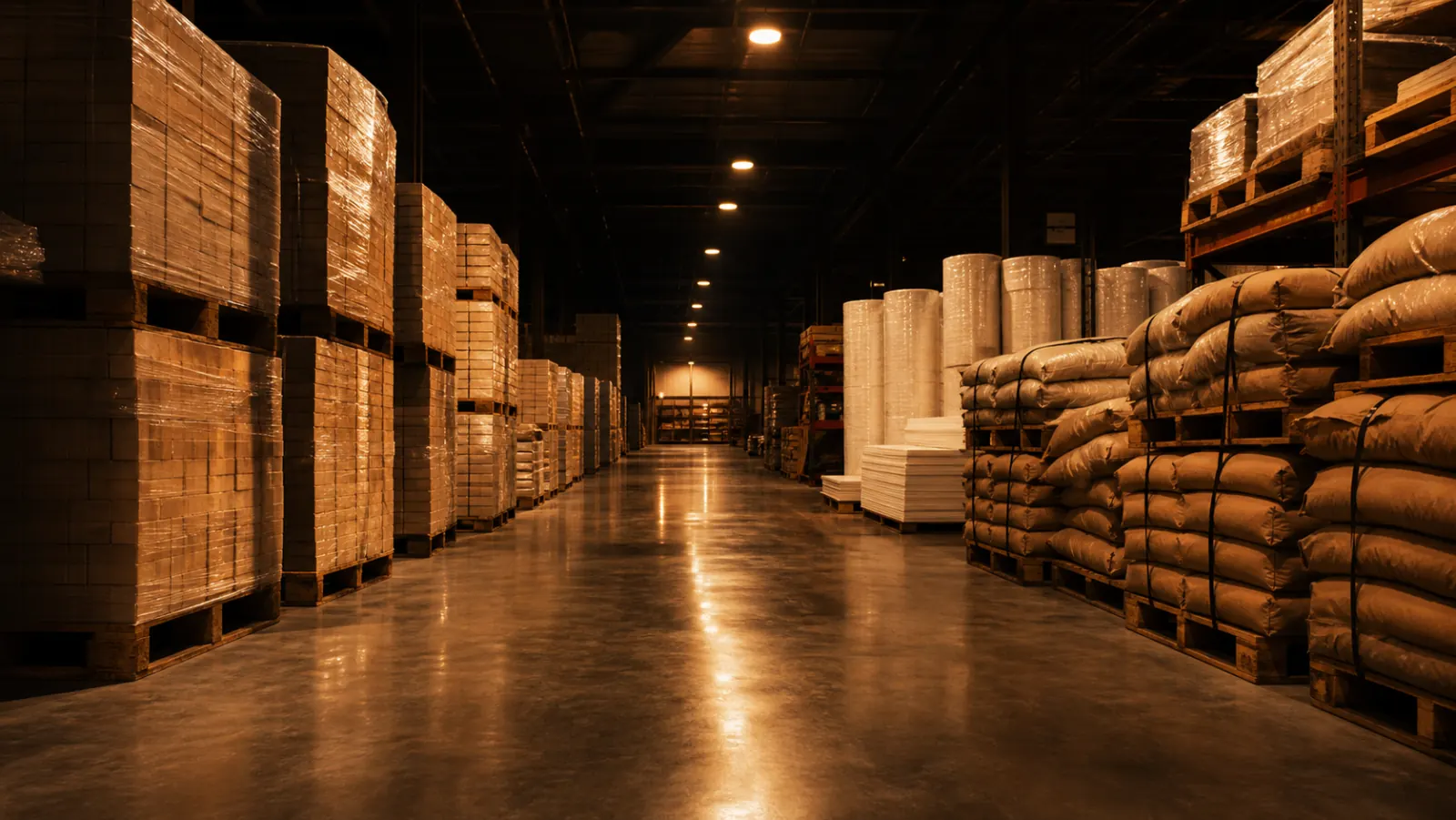
Where the forecasts land: a distributor's aisle
Market reports are written for investors. This one is written for the person who has to raise a purchase requisition, hold a shutdown date and explain a price increase. The headline growth numbers matter less than four things a buyer can act on: where the raw materials come from, what is driving price volatility, how decarbonisation is changing specifications, and which materials are becoming harder to justify on safety grounds.
The numbers, and why they disagree
Published market sizes for refractories vary widely because the analysts draw the boundary in different places — some count only refractory products, others include raw materials and services; some price at ex-works, others at delivered value. Treat every figure below as an order of magnitude with a source attached, not as a fact.
| Source | Global market, 2026 | Growth rate | Horizon |
|---|---|---|---|
| Mordor Intelligence | 59.61 million tonnes (volume basis) | ~3.9% CAGR | 72.31 Mt by 2031 |
| Coherent Market Insights | ~USD 37.1 billion | ~4.3% CAGR | ~USD 49.8 bn by 2033 |
| Fortune Business Insights | ~USD 41.4 billion | ~5.7% CAGR | ~USD 64.6 bn by 2034 |
| Yahoo Finance / market report syndication | ~USD 33.3 billion | ~4.6% CAGR | ~USD 49.7 bn by 2035 |
Figure 2 — four analysts, one market
Global market size in 2026, and where each source thinks it goes
Fortune Business Insights
Coherent Market Insights
Market report syndication
For India specifically the spread is even wider — IMARC puts the market at around USD 2.6 billion in 2025 growing at roughly 3.1% a year, while Grand View Research's India outlook implies something closer to 8% annual growth to 2030. RHI Magnesita's leadership has publicly forecast domestic Indian refractory growth in the 6–13% range, driven by large-scale steel and cement expansion.
Figure 3 — growth, as forecast
Annual growth: global against India
What is not in dispute:
- Asia-Pacific dominates, holding roughly half of global demand — around 48.5% share in 2025.
- India is growing faster than the global average, and faster than most peers.
- The growth is downstream-driven: steel first, then cement, glass, non-ferrous and petrochemicals. Refractory demand is a derivative of steel and cement capacity, so the credible way to forecast your own consumption is to forecast your production, not to apply an industry CAGR.
The practical takeaway for a buyer: demand is rising steadily rather than explosively, which means supply is generally available — but the inputs are where the risk sits.
The real story: raw-material dependence
India imports more than half of its refractory raw-material requirement, including graphite, fused and calcined alumina, magnesite and high-grade clays. Magnesia in particular is largely sourced from China, because India lacks good-quality domestic deposits at scale.
Figure 4 — the number behind the price list
India's refractory raw-material requirement
- Imported>50%
- Domesticthe balance
Figure 5 — how a price increase reaches you
Prices are set upstream, not by your supplier
-
1
An upstream mineral market moves
Chinese magnesia or graphite pricing shifts through export controls, environmental enforcement, energy costs or currency.
-
2
Lead times stretch first
The usual sequence is that a quoted lead time lengthens before a price moves. This is your early warning, and it is free to watch.
-
3
Indian prices follow, one to two quarters later
With a lag. By the time it reaches a price list, the decision window on framework orders has already closed.
-
4
Your budget absorbs it
Or does not, if you placed the framework order at step 2 and qualified the second grade before you needed it.
That single fact explains most refractory price behaviour in India:
- Prices are set upstream, not by your supplier. When Chinese magnesia or graphite pricing moves — through export controls, environmental enforcement, energy costs or currency — Indian refractory prices follow, with a lag of one to two quarters.
- Availability risk is concentrated in specific chemistries. Basic (magnesia) products and graphite-bearing products carry more supply risk than alumino-silicate products made from more widely available inputs.
- Lead times are the early warning. A quoted lead time stretching before a price moves is the usual sequence. If your supplier's lead time on a magnesia grade doubles, plan the next order early rather than waiting for the price list.
Countervailing forces are real but slower: the Atma Nirbhar Bharat push is expanding domestic manufacturing capacity, and global "China+1" de-risking is opening export opportunities for Indian producers. Both improve the structural position over years, not quarters.
Figure 6 — where the risk actually sits
Supply risk by chemistry, not by supplier
| Import dependence | Price volatility | Lead-time risk | |
|---|---|---|---|
| Magnesia-based (basic brick, magnesite) | Magnesia-based (basic brick, magnesite) · Import dependence: Concentrated — largely from China — India lacks good-quality deposits at scale | Magnesia-based (basic brick, magnesite) · Price volatility: Concentrated | Magnesia-based (basic brick, magnesite) · Lead-time risk: Concentrated |
| Graphite-bearing | Graphite-bearing · Import dependence: Concentrated — concentrated import dependence | Graphite-bearing · Price volatility: Concentrated | Graphite-bearing · Lead-time risk: Elevated |
| Fused and calcined alumina | Fused and calcined alumina · Import dependence: Elevated | Fused and calcined alumina · Price volatility: Elevated | Fused and calcined alumina · Lead-time risk: Elevated |
| Alumino-silicate (fireclay, high alumina) | Alumino-silicate (fireclay, high alumina) · Import dependence: Moderate — made from more widely available inputs | Alumino-silicate (fireclay, high alumina) · Price volatility: Moderate | Alumino-silicate (fireclay, high alumina) · Lead-time risk: Moderate |
| Ceramic fibre and calcium silicate | Ceramic fibre and calcium silicate · Import dependence: Moderate | Ceramic fibre and calcium silicate · Price volatility: Moderate | Ceramic fibre and calcium silicate · Lead-time risk: Moderate |
- Low
- Moderate
- Elevated
- Concentrated
What to do about it, practically:
Figure 7 — four things to do this year
Sourcing actions a plant can actually take
None of these require a bigger budget. Three of them require doing something before you need to.
Procurement
The higher-return lever
The fourth is the one worth dwelling on: an extra month of lining life is usually easier to obtain than a price concession, because it comes from installation quality rather than from negotiation — see installation mistakes.
Decarbonisation is a specification issue, not a distant one
The energy transition changes refractory duty in three concrete ways:
1. The EAF and DRI shift. As steelmaking moves from blast-furnace/BOF toward electric arc furnaces and direct-reduced iron, the lining duty changes: different charge mixes, different energy and slag profiles, different wear patterns. Higher DRI use in the EAF changes both electrical and chemical energy demand, which feeds directly into lining selection.
2. Hydrogen. Where hydrogen replaces carbon-based fuel or reductant, the furnace atmosphere changes — more water vapour, different reduction potential — and existing formulations were not designed for it. Refractory formulations are being reworked to withstand the temperatures and corrosion associated with hydrogen use. For most Indian plants this is a three-to-ten-year horizon, but it is a live question today for any new furnace being specified.
3. Alternative fuels in cement. Already here, already changing lining life. Higher thermal substitution raises chlorine, sulphur and alkali loads and shortens preheater and kiln campaigns unless the lining specification and the volatile cycle are managed together — see refractory wear by industry.
The buyer's version of all this: when your process changes, re-specify the lining. A repeat order after a fuel, charge or route change is one of the most reliable ways to buy a short campaign.
Circularity: recycling is becoming a commercial fact
Spent refractory has historically gone to landfill. That is changing quickly, driven by raw-material cost and ESG reporting rather than by regulation alone. Estimates put the recycled refractories market at roughly USD 13.6 billion in 2024 growing toward USD 21.7 billion by 2030 (around 8.6% CAGR), with recycling reported to cut raw-material costs by 20–25% where it can be applied. Major producers have formed joint ventures specifically to recover, process and reuse spent material.
For an Indian plant this shows up in three ways: growing availability of grades with recycled content, a potential revenue or disposal-cost saving on segregated spent lining, and — increasingly — customer or lender questions about what happens to your demolition waste. Segregating spent refractory by type at demolition costs very little and is the precondition for any of it.
The fibre question you should get ahead of
Conventional aluminosilicate refractory ceramic fibre (RCF) is classified as a category 1B carcinogen under the EU CLP Regulation, and IARC classifies refractory ceramic fibre in Group 2B. Low-biopersistence alkaline earth silicate (AES) wools, by contrast, are not classified as carcinogenic by regulatory or advisory bodies — they dissolve in body fluid rather than persisting in the lung.
Figure 8 — ask at the next fibre order
Conventional RCF against low-biopersistence AES wool
| RCF — aluminosilicate refractory ceramic fibre | AES — alkaline earth silicate wool | |
|---|---|---|
| EU CLP classification | Category 1B carcinogen | Not classified as carcinogenic (the better answer for this duty) |
| IARC | Group 2B | Not so classified (the better answer for this duty) |
| Behaviour in the lung | Biopersistent | Dissolves in body fluid rather than persisting (the better answer for this duty) |
| Indian legal position | No blanket ban applies | No blanket ban applies |
| Availability | Widely stocked | Readily available |
| Duty coverage | Needed at the highest temperature classes | A straight substitution for a large share of duty below those classes (the better answer for this duty) |
| If you stay on RCF | Handling controls, PPE and training — documented | — |
India's own regulatory position is not the same as Europe's, and readers should not assume an Indian legal requirement from an EU classification. But the direction of travel is clear, and there are practical reasons to act ahead of any mandate:
- Workforce exposure is a live liability regardless of classification law.
- Export-oriented plants and multinational customers increasingly audit against the stricter standard.
- AES grades are readily available, and for a large share of duty below the highest temperature classes they are a straight substitution.
The practical step is small: when you next order fibre blanket, module or board, ask your supplier for the current safety data sheet and whether an AES grade covers your duty. If it does, the decision is easy. If it does not — high-temperature duty where RCF or polycrystalline wool is genuinely required — then the answer is handling controls, PPE and training, documented.
What all of this means for a plant buying refractories in 2026
| Trend | What it changes for you | Action this year |
|---|---|---|
| Raw-material import dependence | Price volatility and lead-time risk on magnesia and graphite grades | Framework orders, forecast by grade, watch lead times as the leading indicator |
| Steady demand growth | Supply generally available; no panic buying justified | Buy on campaign life, not on scarcity |
| Alternative fuels in cement | Shorter preheater/kiln campaigns | Re-specify lining alongside any TSR increase |
| EAF / DRI / hydrogen | Lining duty changes for new and rebuilt furnaces | Treat new installations as fresh specifications |
| Recycling and ESG | Disposal cost and customer scrutiny | Segregate spent lining at demolition |
| RCF vs AES fibre | Occupational health exposure and audit risk | Request SDS and AES options at next fibre order |
| Input cost inflation | Lining life is worth more than unit price | Invest in installation quality and dryout discipline |
The last row is the one worth repeating. In an environment where material input costs are set by forces well outside your negotiation, the highest-return lever available to most plants is not procurement — it is making the lining you already buy last as long as it was designed to. That is a question of specification, installation and dryout, and all three are within your control.
FAQs
How big is the Indian refractory market?
Published estimates for 2025–2026 cluster around USD 2.6–3.0 billion, with growth forecasts ranging from about 3% to over 8% a year depending on the source and scope. The wide spread reflects different definitions rather than genuine uncertainty about direction — India is growing faster than the global average.
Why are refractory prices in India volatile?
Because more than half of the raw-material requirement is imported — graphite, fused and calcined alumina, magnesite and high-grade clays, with magnesia largely from China. Prices track upstream mineral markets and export policy, not local demand.
Which refractory materials carry the most supply risk?
Generally, magnesia-based and graphite-bearing products, because of concentrated import dependence. Alumino-silicate products made from more widely available inputs tend to be less exposed.
Is ceramic fibre being banned?
No blanket ban applies in India. Conventional refractory ceramic fibre is classified as a category 1B carcinogen under the EU CLP regulation and IARC Group 2B, and low-biopersistence AES wool is not so classified. Many buyers are moving to AES where the duty allows, ahead of any requirement.
Will recycled refractory affect the products I buy?
Increasingly, yes — recycled content in some grades is growing, and segregating spent lining at demolition is becoming standard practice for cost and ESG reasons. It does not change how you specify duty.
Should I be planning for hydrogen now?
For an existing conventional furnace, no. For a new furnace or a major rebuild with a service life measured in decades, yes — the atmosphere and formulation implications are already being worked through by the major producers, and it is cheaper to ask the question at specification than at reline.
Anuj Traders has supplied refractory materials to Indian industry from Ahmedabad for decades, as an authorised dealer and distributor for Calderys, Unifrax and Shubh Ceramics. If you are planning next year's refractory budget or re-specifying after a process change, talk to us about grades, lead times and campaign life.
Products referenced
Where this applies
Sources
- Refractories Market Size, Trends, Growth & Share Analysis 2026-2031 — Mordor Intelligence: https://www.mordorintelligence.com/industry-reports/refractories-market
- Refractories Market Size, Share, Trends, Growth Report 2034 — Fortune Business Insights: https://www.fortunebusinessinsights.com/refractories-market-103287
- India Refractories Market Size, Share, Industry Report 2034 — IMARC Group: https://www.imarcgroup.com/india-refractories-market
- India Refractories Market Size & Outlook 2026-2033 — Grand View Research: https://www.grandviewresearch.com/horizon/outlook/refractories-market/india
- Refractories Market Size, Share and Analysis 2026-2033 — Coherent Market Insights: https://www.coherentmarketinsights.com/market-insight/refractories-market-5395
- Indian Refractory Industry — Infomerics: https://www.infomerics.com/admin/uploads/Steel_Refractory_New_compressed.pdf
- India's Refractory Market: Opportunities for Expansion — Infogence: https://infogence.in/india-refractory-market-opportunities-for-expansion/
- Decarbonisation and the Impact of Hydrogen on Refractory Linings — RHI Magnesita: https://www.rhimagnesita.com/the-bulletin-blog/decarbonisation-and-the-impact-of-hydrogen-on-refractory-linings-in-the-iron-and-steel-industry/
- Recycled Refractories Market Report — Grand View Research: https://www.grandviewresearch.com/industry-analysis/recycled-refractories-market-report
- Refractory Ceramic Fibres — STOP carcinogens at work (EU): https://stopcarcinogensatwork.eu/fact/refractory-ceramic-fibres/
- REACH, CLP and BOELV factsheet — Morgan Thermal Ceramics: https://www.morganthermalceramics.com/media/dgxnlvw1/factsheet11_europe-ehs.pdf
Keep reading