Refractory Wear by Industry: What Actually Kills the Lining in Steel, Cement, Glass, Aluminium, Power and Petrochemicals
Industry applications · Wear mechanisms · Steel · Cement · Glass · Aluminium · Power · Petrochemicals · 14 min read
Anuj Traders · Technically reviewed by Nihar Anuj Desai ·
The same castable behaves completely differently in a steel ladle, a cement preheater and an aluminium holding furnace — because each industry attacks it in a different way. A duty-by-duty map of the dominant wear mechanism in each sector, and what it implies for material choice.
A refractory datasheet describes a material in isolation. What decides its life is what your process does to it — and each industry does something different. This is a duty-by-duty map: the equipment, the dominant wear mechanism, the early warning signs, and what the mechanism implies for material selection.
The mechanisms themselves are described in detail in the failure modes guide; this article is about which ones dominate where.
Quick map
| Industry | Dominant mechanism | Secondary | What usually gets blamed instead |
|---|---|---|---|
| Steel | Slag line corrosion and dissolution | Thermal cycling, erosion at impact zones | "Bad refractory" — usually it is slag chemistry or heat schedule |
| Cement | Alkali, sulphur and chloride infiltration → structural spalling | Coating loss, kiln ovality | Brick quality — often it is the volatile cycle or shell condition |
| Glass | Molten-glass corrosion and vapour-phase attack | Alkali vapour, thermal cycling on backup | Insulation, when the driver is glass chemistry |
| Aluminium | Corundum growth from metal wetting | Thermal cycling, fluxes | Temperature, when the driver is alloy chemistry |
| Power (boilers) | Ash and bed-material erosion | Thermal cycling on start–stop, alkali in biomass | Material hardness, when the driver is flow geometry |
| Petrochemicals | Erosion by catalyst and particulates | Thermal cycling, sulphur/CO conditions | Castable grade, when the driver is dryout or anchoring |
Figure 1 — the same nine mechanisms, weighted differently
Which mechanism dominates in which sector
| Slag / melt corrosion | Infiltration → spalling | Erosion & abrasion | Thermal cycling | Metal wetting | Mechanical & ovality | |
|---|---|---|---|---|---|---|
| Steel | Steel · Slag / melt corrosion: Dominant — the slag line is the single biggest refractory problem in ladle practice | Steel · Infiltration → spalling: Present | Steel · Erosion & abrasion: Secondary driver — tundish impact zone, under the shroud | Steel · Thermal cycling: Secondary driver — ladles that go cold between heats | Steel · Metal wetting: Not a factor | Steel · Mechanical & ovality: Secondary driver — de-skulling damage |
| Cement | Cement · Slag / melt corrosion: Present | Cement · Infiltration → spalling: Dominant — alkalis, sulphur and chlorine condensing in cooler brickwork | Cement · Erosion & abrasion: Secondary driver — cooler and ducting | Cement · Thermal cycling: Present | Cement · Metal wetting: Not a factor | Cement · Mechanical & ovality: Dominant — kiln ovality — a recurring root cause no material fixes |
| Glass | Glass · Slag / melt corrosion: Dominant — molten glass in the contact zones | Glass · Infiltration → spalling: Secondary driver — vapour-phase attack in the regenerators | Glass · Erosion & abrasion: Not a factor | Glass · Thermal cycling: Present | Glass · Metal wetting: Not a factor | Glass · Mechanical & ovality: Present |
| Aluminium | Aluminium · Slag / melt corrosion: Present — fluxes and salts, independently of the metal | Aluminium · Infiltration → spalling: Present | Aluminium · Erosion & abrasion: Not a factor | Aluminium · Thermal cycling: Secondary driver | Aluminium · Metal wetting: Dominant — corundum growth — worst in the wetted bath area | Aluminium · Mechanical & ovality: Present |
| Power (boilers) | Power (boilers) · Slag / melt corrosion: Present — alkali attack where biomass or waste is co-fired | Power (boilers) · Infiltration → spalling: Present | Power (boilers) · Erosion & abrasion: Dominant — circulating bed material and ash-laden gas at velocity | Power (boilers) · Thermal cycling: Secondary driver — start–stop for grid balancing | Power (boilers) · Metal wetting: Not a factor | Power (boilers) · Mechanical & ovality: Secondary driver |
| Petrochemicals | Petrochemicals · Slag / melt corrosion: Present — sulphur species; CO disintegration at 400–600 °C | Petrochemicals · Infiltration → spalling: Not a factor | Petrochemicals · Erosion & abrasion: Dominant — catalyst and particulates in the FCC circuit | Petrochemicals · Thermal cycling: Secondary driver | Petrochemicals · Metal wetting: Not a factor | Petrochemicals · Mechanical & ovality: Secondary driver — thin anchored linings, installed under turnaround pressure |
- Not a factor
- Present
- Secondary driver
- Dominant
Steel
Where the refractory is: blast furnace and stoves, BOF and EAF vessels, ladles (working and safety lining, slag line, well block, purging), tundishes (working lining, impact pads, dams and weirs), runners and troughs, reheating furnaces, ancillary ducting.
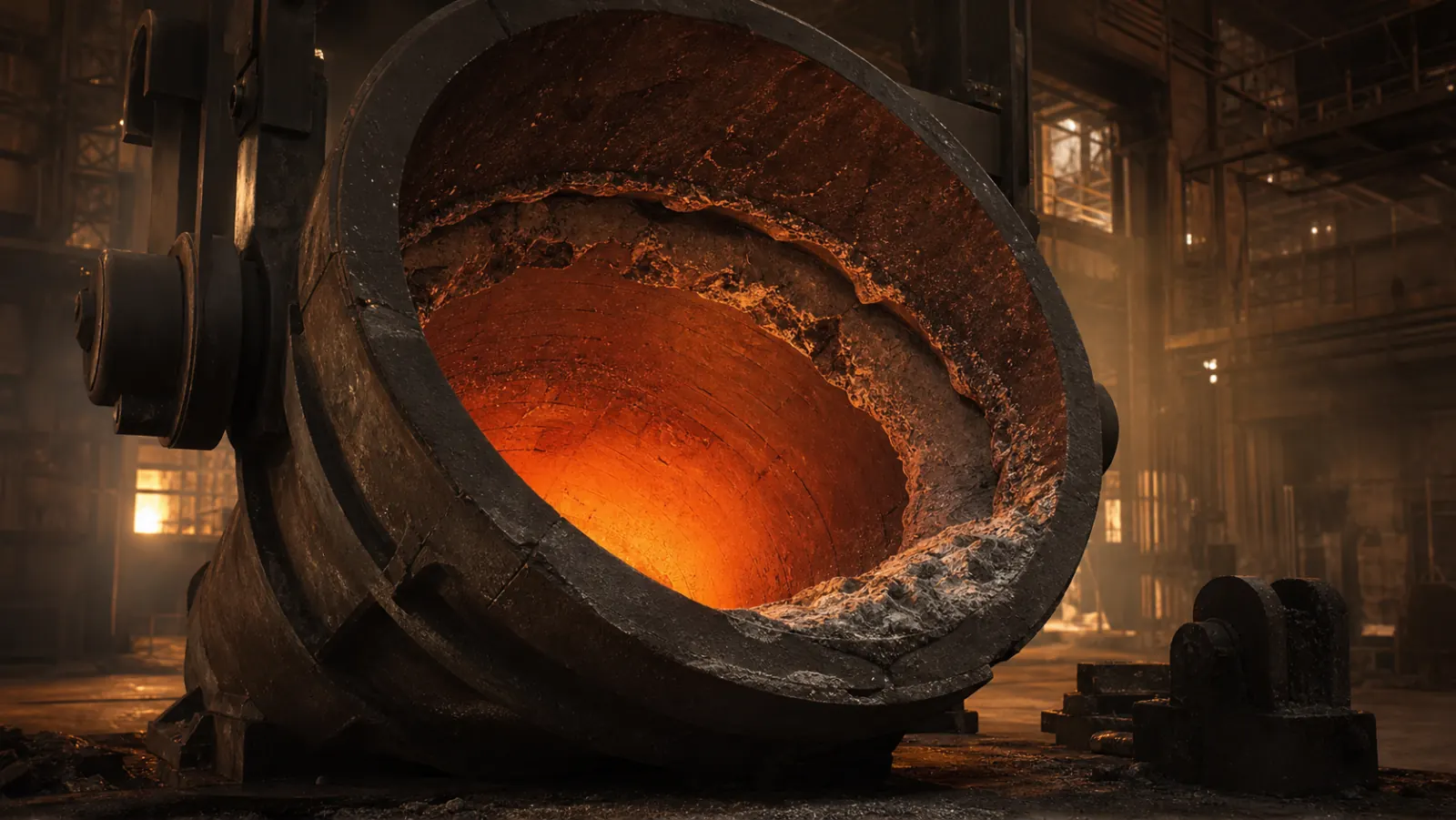
Dominant mechanism: chemical corrosion at the slag line. The slag line is the single biggest refractory problem in ladle practice — chemical, thermal and mechanical wear all act there, with the chemical potential difference between the refractory and the slag providing the driving force, and thermal and mechanical action finishing what the chemistry begins.
Figure 2 — the slag line
Where chemical, thermal and mechanical wear all act at once
Secondary mechanisms: erosion at the tundish impact zone under the shroud and around the stopper rod or slide gate, which creates local hot spots and risks steel penetration into the permanent lining; thermal cycling on ladles that go cold between heats; and mechanical damage during de-skulling.
What to watch:
- Slag chemistry, particularly basicity and FeO/MnO content. A more aggressive slag will shorten campaigns no matter what the lining is made of.
- Cycling and preheating practice. A ladle that is allowed to go cold and is then heated rapidly loses life to thermal shock as well as to chemistry.
- Uneven wear patterns. Wear that maps to flow, not to temperature, is a geometry problem — impact pads, dam and weir arrangement, shroud position.
Implications for selection: chemistry-matched systems — basic refractories against basic slags — with density and low porosity as the second lever. Campaign life is measured in heats, and the honest benchmark is your own vessel's previous campaign, not an industry average; published figures for tundish campaigns vary widely with steel grade mix and practice.
A trend worth planning for: as Indian steelmaking shifts toward EAF and DRI routes, the lining duty changes with it — different charge mixes, different energy profiles and, longer term, hydrogen-rich atmospheres, all of which change what a lining is being asked to survive. This is a specification question for new installations now, not a future one.
Cement
Where the refractory is: rotary kiln (inlet, calcining, transition, burning zone, outlet), preheater cyclones and risers, calciner, kiln hood, cooler, tertiary air duct, ducting and dampers.
Dominant mechanism: infiltration by alkalis, sulphur and chlorine leading to structural spalling. Volatiles released in the burning zone travel with the gas, penetrate the open pores of cooler brickwork and condense there as liquid salts. The condensed salts have a high thermal expansion coefficient, which drives thermomechanical stress and spalls the lining in slabs. Alkalis, sulphur and chlorine migrate through grain boundaries, pores and cracks, and crystallise inside the refractory at lower temperatures.
Secondary mechanisms: coating loss in the burning zone, exposing brick that was designed to work under coating; abrasion in the cooler and ducting; and mechanical damage from kiln ovality and shell deformation.
What alternative fuels change: RDF, tyre-derived fuel, biomass and industrial wastes typically raise the chlorine, sulphur, alkali and heavy-metal load. That directly increases infiltration-driven spalling — one of the most common causes of shortening campaigns in kilns that have recently increased their thermal substitution rate.
What to watch:
- Volatile cycle. Rising chloride circulation is a lining problem before it is an operations problem. A bypass, or feed and fuel control, protects the lining more effectively than a grade change.
- Kiln ovality and shell condition. A recurring root cause that no material can fix.
- Campaign benchmarking. In a modern precalciner kiln, a well-managed lining is generally expected to run in the order of 8–12 months; consistently getting under about six months points to ovality or chemical infiltration rather than a material defect.
Figure 3 — a sanity check, not a target
Burning-zone campaign length, modern precalciner kiln
Generally expected of a well-managed lining
Consistently under this
Implications for selection: low-porosity and specifically alkali-resistant grades in the preheater and calciner; chemistry-matched basic brick in the burning zone; abrasion-resistant dense castables in the cooler and ducts; and joint discipline everywhere, because salt condensation concentrates at joints.
Glass
Where the refractory is: melter (fused-cast in the contact zones, supplied by specialist manufacturers), superstructure, regenerator checkers and walls, forehearth and channels, and — the part most plants buy locally — the entire backup and insulation package behind all of it.
Dominant mechanism: corrosion by molten glass in the contact zones, and vapour-phase attack (alkali, sulphates) on the superstructure and in the regenerators, where condensation on cooler surfaces drives the same kind of infiltration and spalling seen in cement.
What to watch:
- Batch and cullet chemistry changes, which shift the corrosivity of both the melt and the vapour phase.
- Regenerator condensation zones, which fail by a chemical mechanism even though they are the "cold" end.
- Backup insulation integrity. Insulation choices affect the temperature profile through the wall, which changes where vapour condenses — meaning an insulation change can move a corrosion problem rather than solve it.
Implications for selection: contact refractories are specialist fused-cast products; the practical local decisions are in the backup and insulation package — insulating brick, calcium silicate board and block, and ceramic fibre — where thickness, layering and joint staggering set both shell temperature and where condensation occurs.
Aluminium and non-ferrous
Where the refractory is: reverberatory melting and holding furnaces, crucible and induction furnaces, launders and troughs, ladles, and the associated hearths, belly bands and burner quarls.
Dominant mechanism: corundum growth. Molten aluminium wets and penetrates a conventional castable, oxidises within it, and forms corundum that occupies more volume than the metal it came from — cracking and lifting the lining from the inside. Growth is characteristically worst in the wetted bath area, with moderate growth in upper walls and burner quarls where oxygen is available from the atmosphere.
What to watch:
- Alloy chemistry. Alloys containing around 5% magnesium and above are markedly more aggressive. A lining that ran well for years can start failing after an alloy change alone — which is a chemistry problem, not a workmanship one.
- Fluxes and salts, which attack the lining independently of the metal.
- Metal line and belly band, where the bath, the atmosphere and the lining all meet — the classic initiation point.
Implications for selection: non-wetting castables with barrier-forming and pore-blocking additives, installed dense and dried out properly — non-wetting additives do not compensate for a porous or badly cured lining. Field comparisons have shown conventional castables with severe corrosion within months in duty where non-wetting grades showed none.
Power generation
Where the refractory is: CFBC and AFBC boiler combustors, cyclones and loop seals, boiler bed and bull-nose, burner throats and windboxes, ash ducts and hoppers, plus insulation across the whole envelope.
Dominant mechanism: erosion and abrasion. Circulating bed material and ash-laden gas at velocity remove material mechanically wherever the flow turns or accelerates — cyclone inlets and outlets, loop seals, elbows, and any protrusion in the gas path.
Secondary mechanisms: thermal cycling from start–stop operation, particularly on plants that cycle for grid balancing; and, in biomass and waste co-firing, alkali attack that behaves much like the cement case.
What to watch:
- Wear maps that follow the flow. If a lining erodes at one elbow, fix the elbow. Material upgrades at a bad geometry buy time, not a solution.
- Fuel changes, especially to biomass or petcoke blends, which change both abrasivity and chemistry.
- Cycling frequency, which is rising across the sector and quietly changes the right material class toward lower thermal mass and better shock resistance.
Implications for selection: hard, dense, low-cement abrasion-resistant castables at the erosive faces; insulating castables, ceramic fibre and calcium silicate in the backup and envelope; and a serious look at anchoring, because erosive duty and cycling together are hard on anchors.
Petrochemicals and refining
Where the refractory is: fired heaters and reformers, FCC reactors, regenerators and transfer lines, sulphur recovery thermal reactors, incinerators, flue gas ducts, stacks and expansion joints.
Dominant mechanism: erosion by catalyst and particulates in the FCC circuit, combined with thermal cycling and, in specific units, chemical attack from sulphur species and reducing conditions.
What to watch:
- Catalyst circulation paths, where erosion concentrates.
- Reducing, CO-rich conditions in the 400–600 °C range, which is exactly the window for CO disintegration in iron-bearing refractories — a low-temperature mechanism that shows up in ducts and offtakes rather than in the hot zone.
- Anchoring and dryout quality, which in this sector cause a disproportionate share of failures because linings are thin, anchored, and often installed and dried under severe turnaround time pressure.
Implications for selection: abrasion-resistant dense castables at erosive surfaces, CO-resistant low-iron grades where reducing conditions and moderate temperature coincide, careful anchor specification, and dryout schedules planned into the turnaround rather than compressed at the end of it.
The common thread
Across all six industries, three things decide lining life more often than the grade on the bag:
Figure 4 — rule these out first
Three things that beat the grade on the bag
-
1
A process change nobody linked to the lining
Fuel, slag, alloy, scrap mix, throughput, cycling. Most "sudden" material problems follow a process change by one to three campaigns.
-
2
Geometry and mechanical condition
Flow paths, ovality, anchors, expansion joints. No material fixes any of these — a harder grade buys an interval, not a solution.
-
3
Installation and dryout quality
Where a correctly specified lining gets quietly destroyed before it ever runs. Invisible on the commissioning report, obvious three months later.
Figure 5 — start from the change, not the symptom
What changed in the last one to three campaigns?
Pick the change
Expect a chemistry problem, not a temperature problem
Alternative fuels typically raise the chlorine, sulphur, alkali and heavy-metal load in the gas stream. Those volatiles condense as high-expansion salts inside cooler brickwork and drive infiltration-led structural spalling.
Re-specify alongside the change: denser hot face, tighter joints — and upstream control of the volatile cycle, which does more than any grade change. In power, a switch to biomass or petcoke changes both abrasivity and chemistry at once.
The lining did not get worse; the attacker did
In aluminium, alloys containing around 5% magnesium and above are markedly more aggressive — a lining that ran well for years can start failing after an alloy change alone. In steel, a more aggressive slag basicity or a higher FeO/MnO content shortens campaigns no matter what the lining is made of.
This is a chemistry problem, not a workmanship one, and the honest response is a chemistry-matched re-specification.
Treat it as a fresh specification
Moving from blast furnace and BOF toward EAF and DRI changes the charge mix, the energy profile and the slag chemistry; longer term, hydrogen-rich atmospheres change the reduction potential and water vapour content too.
For a new furnace or a major rebuild, ask the lining question at specification rather than at the first reline — a repeat order after a route change is one of the most reliable ways to buy a short campaign.
Shift the material class, not the grade
More frequent start–stop operation quietly changes the right answer toward lower thermal mass and better shock resistance — which often means less dense and less strong at the hot face, not more.
And the cheapest fix is operational: most thermal-shock damage in cycling plant is introduced during heat-up and cool-down, not at temperature.
Then look at geometry and installation
If the process genuinely has not moved, the variable is the vessel or the crew. Wear that maps to the flow path rather than to temperature is a geometry problem — an elbow, a protrusion, a shroud position, an impact pad arrangement.
Wear that is uniform and premature usually points back to the installation and dryout: water measured by eye, thin vibration, or a compressed heat-up. Ask for the installation record before ordering a higher grade.
What to send us
Figure 6 — for a duty-specific recommendation
What we need from your sector
The last two items are what separate a recommendation from a price list.
Where it is
What attacks it
History
FAQs
Which industry is hardest on refractory linings?
They are hard in different ways, so the question is really which mechanism dominates. Steel ladle slag lines and aluminium metal lines are among the most chemically aggressive; cement preheaters and calciners face the most severe infiltration; CFBC cyclones and FCC circuits are the most erosive.
Why did our cement kiln lining life drop after we increased alternative fuels?
Because alternative fuels typically increase chlorine, sulphur and alkali in the gas stream. Those volatiles condense as salts inside cooler brickwork and drive infiltration-led structural spalling. The durable fix combines a denser hot face and tighter joints with upstream control of the volatile cycle.
What causes corundum growth in aluminium furnaces?
Molten aluminium wetting and penetrating the refractory, then oxidising inside it to form corundum, which occupies more volume and cracks the lining outward. Magnesium-bearing alloys accelerate it markedly. Non-wetting castables installed dense are the standard defence.
Our boiler refractory erodes in the same spot every outage. Is it the material?
Usually not. Repeated wear at one location is a flow problem — an elbow, a protrusion, a velocity increase. A harder material extends the interval; correcting the geometry or adding local protection solves it.
How does the shift to EAF and DRI steelmaking affect refractory choice?
It changes the charge mix, the energy profile and eventually the furnace atmosphere, all of which change lining duty. Refractory formulations are being reworked around higher DRI use and hydrogen-rich atmospheres, so it is worth treating new installations as a fresh specification rather than a repeat order.
Anuj Traders supplies refractory materials and application support to steel, cement, glass, aluminium, power and petrochemical plants from Ahmedabad, as an authorised dealer and distributor for Calderys, Unifrax and Shubh Ceramics. Tell us the equipment and the wear pattern and we will tell you which mechanism we think you are fighting.
Products referenced
Where this applies
Sources
- Refractory Wear & Brick Life in Cement Kilns — cementequipment.org: https://www.cementequipment.org/home/wear-of-refractories-particularly-when-using-waste-fuels-and-their-influence-on-the-brick-life/
- Sulphur and chloride cycles and the use of alternative fuels — ECRA: https://www.ecra-online.org/newsletters/sulphur-and-chloride-cycles-and-the-use-of-alternative-fuels-or-raw-materials
- Steel Ladle Lining Management — RHI Magnesita: https://www.rhimagnesita.com/the-bulletin-blog/steel-ladle-lining-management/
- Effect of slag on the working lining of tundish — Metal World Insight: https://metalworldinsight.com/effect-of-slag-on-the-working-lining-of-tundish-part-1/
- Refractory Management Across Steelmaking: BOF, EAF, Ladle & Tundish — Oxmaint: https://oxmaint.com/industries/steel-plant/refractory-management-steelmaking-bof-eaf-ladle
- Causes of corundum growth in aluminium reverberatory furnace linings — M. Addis: https://www.linkedin.com/pulse/causes-corundum-growth-associated-degradation-aluminium-matthew-addis
- Refractory non-wetting properties against molten aluminium — J. Pulbrook: https://www.linkedin.com/pulse/refractory-non-wetting-corrosion-resistant-properties-john-pulbrook
- Decarbonisation and the impact of hydrogen on refractory linings — RHI Magnesita: https://www.rhimagnesita.com/the-bulletin-blog/decarbonisation-and-the-impact-of-hydrogen-on-refractory-linings-in-the-iron-and-steel-industry/
Keep reading