Your Reheating Furnace Hearth Isn't Failing From Heat. It's Dissolving in Its Own Scale.
Magnesite · Rolling mills · Reheating furnaces · Material selection · Steel · 12 min read
Anuj Traders · Technically reviewed by Nihar Anuj Desai ·
Every re-rolling mill that has replaced a hearth early knows the pattern: the brick was rated well above the furnace temperature, and it still went. The reason is chemistry, not heat — molten mill scale attacks high alumina brick at around 1200 °C. This is why 90% magnesite is the right brick for that specific job, and where it is not.
Here is a conversation we have had many times, in more or less these words:
"We bought good brick. Seventy per cent alumina, rated well above what the furnace runs at. And the hearth is gone in the soaking zone again."
The brick was not the problem, and neither was the temperature rating. The problem is that a reheating furnace hearth is not a hot-temperature duty. It is a chemical duty, and the chemical is the scale coming off your own billets.
Once you see it that way, the material choice stops being a debate about alumina percentages and becomes obvious.
What is actually happening on your hearth
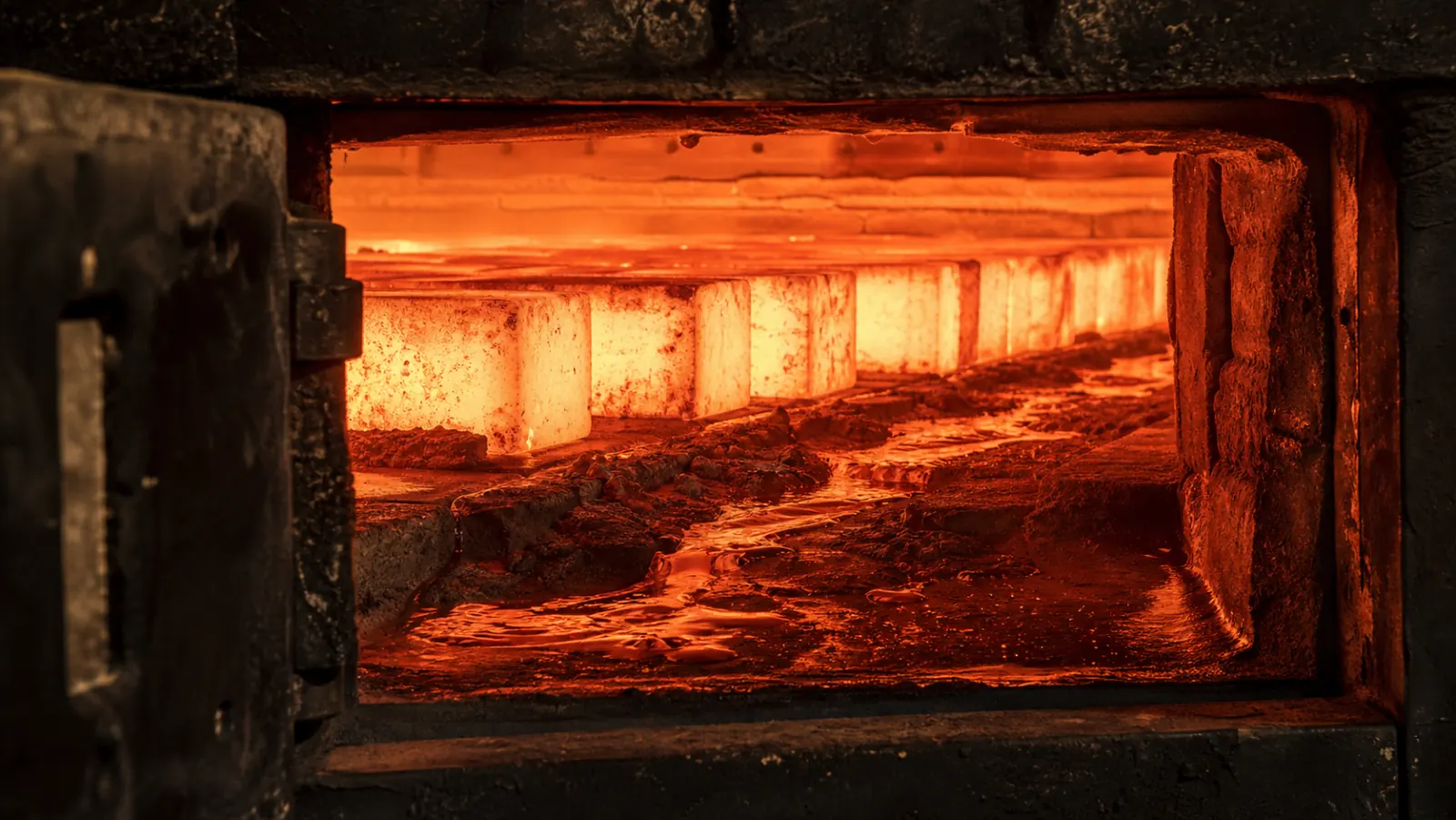
Every billet, bloom and slab that goes through a reheating furnace oxidises. That oxide layer — mill scale — is a mix of wüstite (FeO), magnetite (Fe₃O₄) and hematite (Fe₂O₃), with FeO dominating at the temperatures your furnace runs at. It flakes off, it collects on the hearth and around the skids and rails, and in the soaking zone it becomes fluid and flows across the refractory surface.
That liquid is a slag. And it is a slag that is chemically hungry for exactly what an alumino-silicate brick is made of.
Figure 1 — the actual attacker
Liquid mill scale, running across the hearth
Why high alumina brick loses this fight — at 1200 °C, not 1700 °C
This is the part that surprises people, because the number on the datasheet looks so comfortable.
FeO reacts with the silica in an alumino-silicate brick to form fayalite (2FeO·SiO₂), which melts at roughly 1200 °C. So the moment liquid scale reaches a silica-bearing brick, the brick starts generating its own low-melting phase at a temperature it is supposed to shrug off. The surface progressively liquefies and washes away. Your 1700 °C brick is being dissolved at 1200 °C.
It gets worse when you look at what the brick can and cannot absorb. High alumina refractories finish as mullite and silica, or corundum and mullite. Those crystalline phases can accommodate iron in their lattices — but only in the ferric state (Fe³⁺). Where the iron oxide is present as FeO (ferrous, Fe²⁺) — which is precisely the case in a reheating furnace hearth — that substitution is not available. The published work on soaking zone hearths is blunt about the consequence: even a small amount of absorbed iron oxide develops liquid above about 1210 °C, and failure follows.
The broader finding in the literature is the same. Alumina-silica refractories are simply not suitable for FeOx-rich slags, because FeOx drives the formation of liquid phases at low temperatures; once 25–35% FeOx has been absorbed into the material, liquid can form at temperatures down to around 1205 °C.
Figure 2 — why the datasheet reassures you
The rating you bought against the temperature that matters
°C
- Liquid forms in the brick once it has absorbed iron oxide1205–1210 °C
- Fayalite (2FeO·SiO₂) melts1200 °C
- The number on the 70% alumina datasheet1700 °C
So the failure sequence on a high alumina hearth is:
Figure 3 — the loop
How a high alumina hearth gives itself away
-
1
Liquid scale wets the brick surface
FeO-dominated, fluid at soaking-zone temperature, and free to flow wherever the hearth falls away.
-
2
FeO reacts with the silica in the matrix
The product is fayalite, 2FeO·SiO₂ — molten at roughly 1,200 °C. The brick has manufactured its own low-melting phase.
-
3
The softened surface is washed away
The next flow of scale carries the liquefied layer off with it. Thickness is lost without any dramatic cracking.
-
4
Fresh brick is exposed
A new silica-bearing surface, and the reaction starts again on it.
…and it accelerates: the washed surface is now rough, so it holds more scale than it did when it was new.
Why 90% magnesite wins — the magnesiowüstite mechanism
Magnesia (MgO) does the opposite of what silica does when it meets FeO.
MgO and FeO form a solid solution — magnesiowüstite — not a low-melting eutectic. Iron diffuses from the slag into the magnesia grains and transforms them into magnesiowüstite, which is a high-melting solid. Instead of generating a liquid that runs away, the hearth face develops a dense, iron-enriched solid layer that sits there and takes the abuse.
That is the whole argument in one line: against iron oxide, silica makes a liquid and magnesia makes a solid.
Two supporting reasons the 90% grade is the practical choice:
- Purity closes the side doors. The vulnerability in any basic brick is the bonding phase between the magnesia grains. The higher the MgO content, the less silicate bonding phase there is for FeO to find, and the fewer routes exist to a low-melting compound. A 90%+ MgO grade is the commercially standard point where that protection is real and the price is still sane for a re-rolling mill.
- Basic against basic. This is the general rule from material selection: match chemistry to chemistry. A ferrous, basic-leaning slag wants a basic refractory. Putting an acidic/neutral alumino-silicate against it is the textbook mismatch, and it fails in the textbook way.
Zone-by-zone practice in the steel industry reflects exactly this: the heating and soaking zone furnace bottom — the part that has to resist iron oxide slag corrosion — is where magnesia and magnesia-chrome brick belong, while alumina-silica brick does the walls and roof perfectly well.
One more point in magnesite's favour in 2026: it is chrome-free. Magnesia-chrome was the traditional answer for this duty, and it works, but hexavalent chromium formation makes spent mag-chrome a disposal and EHS problem that a growing number of buyers no longer want. Straight magnesite sidesteps that entirely.
Head to head, for a hearth
Figure 4 — for this duty only
High alumina against 90% magnesite on a scale-wetted hearth
| High alumina brick (e.g. 70%) | 90% magnesite brick | |
|---|---|---|
| Reaction with FeO scale | Forms fayalite (2FeO·SiO₂), molten ~1200 °C | Forms magnesiowüstite, a high-melting solid (the better answer for this duty) |
| Net effect on the hot face | Surface liquefies and washes away | Dense iron-enriched solid layer forms (the better answer for this duty) |
| Effective limit in this duty | Set by the chemistry (~1200 °C), not the rating | Set by the material, well above hearth service (the better answer for this duty) |
| Basic slag resistance | Poor | Excellent (the better answer for this duty) |
| Thermal shock resistance | Better (the better answer for this duty) | Lower — matters on a cycling furnace |
| Hydration risk in storage | Low (the better answer for this duty) | Real — must be stored dry |
| Thermal conductivity | Lower (the better answer for this duty) | Higher — backup insulation matters more |
| Density / structural load | Lower (the better answer for this duty) | Higher — check the hearth structure |
| Cost per brick | Lower (the better answer for this duty) | Higher |
| Cost per campaign in scale-wetted duty | Usually much higher | Usually much lower (the better answer for this duty) |
Where magnesite belongs — and where it does not
We would rather sell you the right brick for each zone than the same brick for the whole furnace, so here is the honest boundary.
Figure 5 — one furnace, two families
Where the scale collects is where the brick changes
Roof, walls and upper structure
Hearth and furnace bottom
-
Charge end
High aluminaHigh alumina — little liquid scale this cold -
Heating zone
High aluminaMagnesite in mills running heavy scale -
Soaking zone
High alumina90% magnesite — scale is fluid here -
Discharge end
High aluminaMagnesite — scale accumulates and runs off
Use 90% magnesite where scale collects and goes liquid:
- soaking zone hearth and furnace bottom
- heating zone bottom in mills running heavy scale
- skid and rail surrounds, and the areas that catch run-off
- scale pockets, drop zones and the tapping/discharge end where scale accumulates
Do not use it just because it is "the better brick":
- Roof, walls and upper structure — no scale contact, and here the alumino-silicate family's lower conductivity, lower weight and better thermal shock behaviour are genuine advantages. High alumina is the right answer.
- Furnaces that cycle hard. Magnesite's thermal shock resistance is lower than alumino-silicate. A furnace that is fired and killed frequently — common in smaller re-rolling operations working to order — needs that weighed carefully, and sometimes the correct answer is a well-chosen high alumina hearth with a planned repair interval rather than magnesite.
- Anywhere the slag is acidic, where the whole logic reverses.
- Where the hearth structure cannot take the extra weight without checking.
And one storage warning that is not optional: basic brick is sensitive to hydration. MgO reacts with atmospheric moisture, and hydrated brick loses strength and can spall in service. Store it dry, off the floor, under cover, and do not let pallets sit through a monsoon in an open yard. That single habit decides whether the brick you bought is the brick you install — see installation mistakes.
The number that actually matters
Magnesite costs more per brick. It is the wrong comparison, and every mill that has done the arithmetic knows it.
Work it out on your own furnace instead of taking anyone's word for it:
Cost per month of hearth life
  = (brick cost + mortar + labour + scaffolding/access + fuel for dryout
     + production lost during the outage)  ÷  months of hearth life achieved
Two things fall out of that formula every time:
- The material is the small term. On a hearth repair, brick cost is frequently dwarfed by the outage — lost rolling hours, restart fuel, and the crew. If magnesite extends the interval meaningfully, it wins even at a large price premium, because it removes whole outages rather than making one cheaper.
- It is your numbers, not an industry average. We are deliberately not printing a "×3 life" claim here, because campaign life on a reheating furnace depends on your scale loading, your soaking practice, your cycling pattern and your hearth design. What we can tell you is the mechanism — and the mechanism says the alumino-silicate hearth is losing to a reaction it cannot win.
If you have records of your last two hearth campaigns, we can do that calculation with you properly rather than in the abstract.
What we supply, and what we need from you
We stock Magnesite Brick — 90% and Magnesite Brick — 91% as part of the Calderys range, alongside the high alumina 30–80% series for the walls and roof, matched mortars, and the insulating castables and boards that go behind the hot face. Published specification values for each grade are on the product pages and on the manufacturer's datasheet — ask us for the current sheet with any quotation rather than working from a figure in an article.
To quote a hearth properly, send us:
Figure 6 — the hearth enquiry
What we need to quote a hearth
The last item is worth more than the rest combined — a cross-section tells us whether this is chemical dissolution, structural spalling or mechanical damage, and those have three different answers.
The furnace
The hearth as built
The evidence
That last one is worth more than the rest combined. A cross-section of the failed brick shows whether you are looking at chemical dissolution, structural spalling or mechanical damage — and those three have three different answers. See how to read a failed lining.
FAQs
Why is magnesite better against iron oxide scale?
MgO and FeO form magnesiowüstite, a high-melting solid solution, rather than a low-melting liquid. The reacted layer stays put as a dense solid instead of running off, so the hot face is protected rather than progressively dissolved.
Why 90% MgO specifically — is higher always better?
The bonding phase between magnesia grains is the vulnerable part of a basic brick. Higher MgO content means less of that silicate bonding phase and fewer routes to a low-melting compound. 90% and above is the commercial grade where the protection is substantial and the cost still makes sense for a re-rolling mill hearth; going higher pays off in more severe duty than most reheating furnaces present.
Should I use magnesite for the whole reheating furnace?
No. It belongs where scale collects and goes liquid — the hearth and furnace bottom, skid surrounds, scale pockets and the discharge end. Roof, walls and upper structure are better served by high alumina brick, which is lighter, less conductive and more tolerant of thermal cycling.
Is magnesite brick difficult to store?
It needs care. MgO hydrates on contact with atmospheric moisture, and hydrated brick loses strength and can spall in service. Store dry, off the floor, covered, and use it in the order it arrives. In Indian monsoon conditions this is a real risk, not a theoretical one.
Is magnesite better than magnesia-chrome for this duty?
Magnesia-chrome performs well and was the traditional choice, but spent chrome-bearing refractory raises hexavalent chromium disposal and EHS issues. For most reheating furnace hearth duty, chrome-free magnesite gives you the mechanism you actually need without inheriting that problem.
What about thermal shock — our furnace cycles a lot?
Then weigh it carefully. Magnesite's thermal shock resistance is lower than alumino-silicate's. On a hard-cycling furnace the right answer may be a magnesite hearth only in the scale-wetted zones with the rest in high alumina, or a planned repair interval on an alumino-silicate hearth. Tell us your cycling pattern and we will say so plainly.
Anuj Traders has supplied refractories to Gujarat's steel and re-rolling sector from Ahmedabad for decades, as an authorised dealer and distributor for Calderys, Unifrax and Shubh Ceramics. If your hearth is going early, send us the last two campaign records and a photo — we will tell you which mechanism you are fighting before we quote you a brick.
Products referenced
Where this applies
Materials
Industrys
Sources
- Reheating furnace's soaking zone hearth refractories — a rational approach (National Metallurgical Laboratory, India): https://eprints.nmlindia.org/5547/1/158-170.PDF
- Interfacial reaction between magnesia refractory and FeO-rich slag: formation of magnesiowüstite layer — Ceramics International: https://www.sciencedirect.com/science/article/abs/pii/S0272884219304110
- Study of dynamic refractory wear by slags containing very high FeO contents under steelmaking conditions — Ironmaking & Steelmaking: https://www.tandfonline.com/doi/full/10.1080/03019233.2020.1827672
- Fayalite slag — ScienceDirect Topics overview: https://www.sciencedirect.com/topics/engineering/fayalite-slag
- Heating furnace refractory — zone-by-zone material selection: https://www.aluminabricks.com/industrial-refractory/steel-industry-refractories/heating-furnace-refractory/
- Which is better, magnesia brick or high alumina brick? — Rongsheng: https://rongshengrefractory.com/which-is-better-magnesia-brick-or-high-alumina-brick/
- Mill scale composition (wüstite, magnetite, hematite) — reference overview: https://www.lmmgroupcn.com/iron-scale/
Keep reading